
Selling a company means encountering a language of its own. This glossary explains the terms that come up most often, in the order in which you are likely to meet them.
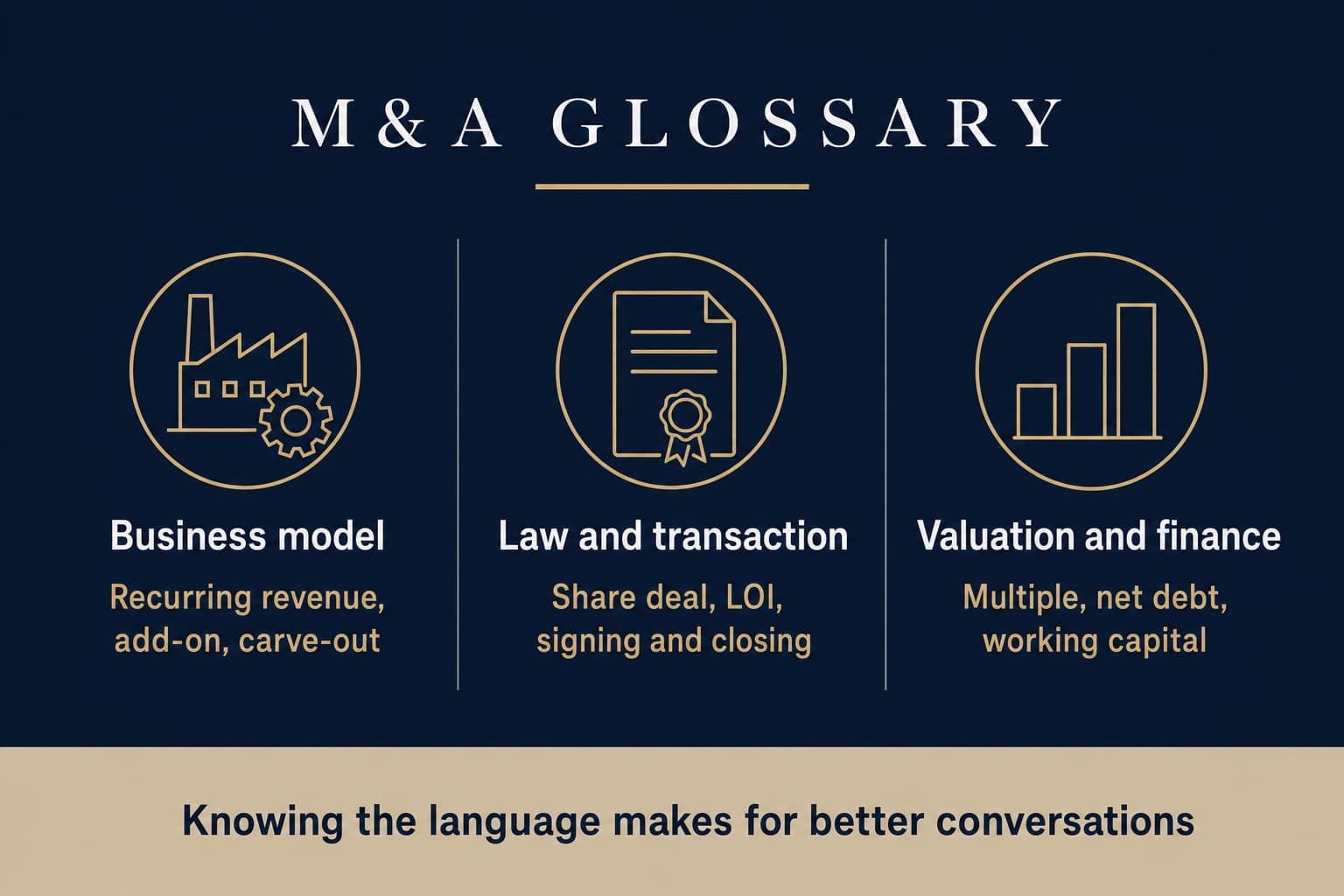
Business model and industry
- Recurring revenue
- Income that arrives predictably from contracts, subscriptions or long-term service agreements. One of the strongest single drivers of valuation.
- Add-on
- An acquisition that complements an existing platform, adding a product, a geography or a customer group.
- Carve-out
- The separation of a business unit from a larger group or company, sold as a standalone entity.
- Buy-and-build
- A strategy of acquiring a platform company and adding smaller businesses to it over time.
Law and transaction
- Asset deal
- The sale of individual assets rather than shares, often chosen to control which risks transfer.
- NDA
- A non-disclosure agreement, signed before any identifying information is shared.
- Indicative offer
- A non-binding first view on price and structure, usually before due diligence and without final contract terms.
- LOI
- A letter of intent, setting out the key deal parameters before due diligence begins. Mostly non-binding on price, binding on exclusivity and confidentiality.
- Binding offer
- A firm offer. It contains the essential contract terms and, unlike an indicative offer, commits the buyer.
- Due diligence
- The buyer's examination of the business, covering finance, tax, legal, commercial and, where relevant, technology.
- Data room
- The secured document repository in which due diligence material is made available, with access rights per party.
- SPA
- The share purchase agreement, containing the price mechanism, warranties, indemnities and closing conditions.
- Warranties and indemnities
- Assurances about the state of the business, and specific protection against identified risks.
- W&I insurance
- Warranty and indemnity insurance, covering the seller's exposure under those assurances.
- Escrow
- A portion of the purchase price held by a third party to secure potential warranty claims.
- Signing and closing
- The signature of the contracts and the legal transfer of ownership, usually separate dates.
- Retrade
- A renegotiation of price or structure after due diligence, typically on the back of findings.
- MBO and MBI
- A management buy-out, where existing management acquires the business, and a management buy-in, where external managers do.
- Rollover
- The seller reinvesting part of the proceeds into the continuing company, staying invested alongside the buyer.
Valuation and finance
- Multiple
- The valuation factor applied to earnings, for example enterprise value divided by EBITDA. Depends on sector and size.
- Enterprise value
- The value of the operating business, before deducting net financial debt.
- Equity value
- What reaches the seller, after net debt and working capital adjustments.
- Net debt
- Financial liabilities less cash, plus anything the buyer treats as debt-like, such as pension provisions or leasing.
- Working capital
- The operating capital tied up in the business. Compared against a normal level and frequently subject to adjustment at closing.
- Locked box
- A price fixed on a historical balance sheet date, with no closing accounts.
- Closing accounts
- A price adjustment based on accounts drawn up at the closing date.
- Adjusted EBITDA
- Earnings normalised for one-off and non-operating effects. The level on which the price is built.
- Earn-out
- A portion of the price contingent on future performance, measured against defined metrics.
- Vendor loan
- Part of the purchase price deferred and lent to the buyer by the seller.
- BATNA
- The best alternative to a negotiated agreement. Knowing yours is what makes a negotiating position credible.
Where to start
If you read only four entries, read multiple, net debt, share deal versus asset deal, and signing versus closing. Those four explain most of what happens to the number between the first offer and the payment.
Next step
A first indication of value takes two minutes in the calculator. For anything beyond that, a conversation is quicker.